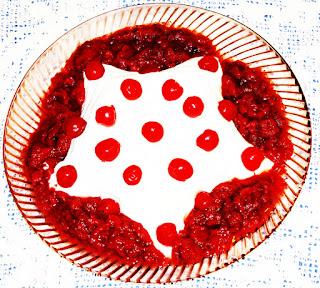
Several weeks ago I mentioned a classic French dessert I serve at Christmas that I make light to keep the calories down after a heavy meal. I gave it the wrong name, Creme Brulee.
Coeur a la Creme is the correct name. It can be made in advance and improves with age. A number of readers have asked for the recipe, so here it is with my changes to light and fat-free ingredients.
Coeur a la Creme is most frequently formed in heart shaped molds with drain holes in the bottom. I found a five-pointed shaped wicker basket at the Dollar Store. I scrubbed it and boiled it for ten minutes to remove any manufacturing residue so it would be safe to use in food preparation.
Neufchatel cream cheese is used instead of the whipped or fat-free cream cheese because it gives a creamier texture to the finished product. It has 1/3 less fat than regular, but new research indicates we need a few fats in our diet. I think of them as lubrication for aging joints.
It's like when cholesterol was first indicated as a problem in heart disease all foods containing it were considered it bad. More in-depth research has shown there is both good and bad, the same is proving true for fats, but the jury is still out on amounts, types, & kinds.
Coeur a la Creme
Makes 6 small molds, 1 large or is easily cut in half for a small family
2 8 oz. packages of Neufchatel cheese
10 fluid ounces of fat-free half & half
2 egg whites
Set out ingredients and allow them to rise to room temperature. Line molds with cheesecloth and put aside until needed.
Gently push cream cheese through a sieve or use a food processor. Add half & half, beat into cheese until it is thoroughly blended and the mixture is smooth. In a medium-sized bowl (copper or glass, never plastic) beat eggs whites until they form stiff peaks. With a metal spoon, gently fold stiff egg whites into the cheese mixture. Spoon the cheese mixture into the cheese cloth prepared molds. Place the mold or molds on a indented plate - soup bowls or berry bowls work well to allow the excess moisture to drain. Place in the refrigerator for 12 hours or overnight. To serve: Invert the mold onto a plate or platter. Gently remove the cheesecloth and decorate. Nash used Maraschino cherries with crushed strawberries for the sauce, but you can use any crushed fruit, nuts, ice cream toppings, or melted jams & jellies. They can be held in the refrigerator until time to put on the table and the decorating will keep children busy while finishing in the kitchen.
PS: I deliberately left out 1/8th teaspoon of salt as there is enough salt in the ingredients. It isn't needed.
Have a wonderful holiday with your friends and family from out home to yours.
Nash Black, author of Legacy of Death

Our mail box sits by the side of the road and meets almost all of the US Postal Services regulations as to distance from the pavement and accessibility. Since we live outside the metropolitan area our newspaper does not arrive until the next day so in terms of frog-hair-splitting we are reading history instead of the news, but we enjoy it just the same.
During the holidays the mailbox takes on added significance when cards begin to arrive from far-flung family and friends. Many people don't write letters when an e-mail or post on Facebook will suffice, but they will include a note or printed sheet to catch you up on all their happenings during the past year with a holiday greeting.
I'm not sure the current school age generation learns the fine art of letter writing in their world of texting. I can hear the groans across the miles when the young are confronted the chore of dropping a thank you note in the mail to a cranky old great-aunt who expects a response for a gift.
It begins before Halloween when the mailbox is stuffed with a deluge of mail order catalogs. Many are from companies you've never heard of because once you did order something, even if it was 20 years ago. Your name and address go in computer files which are sold to other companies which are then sold ad infinitum. Catalogs are bread & butter to the postal service because someone out there is paying the postage to have them delivered to your box.
Though I fuss & fume about the high cost of postage & handling every once-in-a-while I succumb to the lure of a catalog item. This time it was a much needed photographic accessory - a pair of mittens constructed with a flip cover that exposes partially covered fingers allowing me to operate the controls on my camera. I vow it is my last junk item order as the expenses of purchase were twice the cost of the gloves. I rationalized my purchase as being the only source I could find that offered the item I needed.
Rural mail delivery is a time honored tradition. Going to the mailbox is a social occasion to meet your neighbors who are there for the same reason to discover what the mail person left for you. Driving through the country down rough back roads it is still possible to find rotting in the weeds the remains of a horse trough. Residents provided a source of water for the mailman's horse to take a drink before he plodded along the road to the next box.
If someone was elderly and lived alone had not collected their mail for several day the postman was sure to go up to the house to check on them and notify their neighbors if they needed help. When my sister died the post office personnel already knew to stop her mail before I arrived to issue the request. The mail delivery person had passed on the road while the medical officials were still in the house.
During the holidays people left small gifts or coins in their boxes as a token of their appreciation for the service. This was still true in the small town where I grew up. My mother always had a box of cookies and fudge for the mailman. Today I wonder what he did with all those offerings as everyone on the street was doing the same thing. He repaid her kindness one day when her puppy wandered away and got lost. He found the dog on another street, stuffed it in his mail bag, and brought him home.
Going to the mailbox is a fascinating way in small towns and rural areas to learn the meaning of the holidays from family and friends when they remember you with cards & letters. So hang a wreath or tie a bow around your mailbox to salute the carrier who brings you gifts each day.
The illustration is by Barbara Appleby, it looks as if she drove by and took a photograph of our box.
Nash Black, author of Legacy of Death.

One of the delightful holiday traditions that is enjoyed by people around the world is caroling, which has an obscure history with frequent "it may have been" in the articles I've read. The one thing I do know is people enjoying singing and listening to music and that has a history which reaches back to the earliest days of human interaction.
The word carol means a dance or a song and was associated with the breaking of the winter solstice when days become longer and darkness fades. Another word associated with the carols is noel. Noel is French and means Christmas song or hymn.
The best I could discover is that singing stories of the Christian tradition may have begun in the 4th century, but the words or chants were in Latin, which was the language of the church. It wasn't until the 13th century when joyful music as opposed to the secular or more somber music because the spirit of the day, at least on the streets and in the homes of people where some of the songs we know today originated.
The early street singers were called "waits" and strolled the streets on Christmas Eve. They were celebrating the shepherds who on "wait night or watch night" were the first to learn of the birth as they watched their sheep. In non-religious terms the singers may have been waiting to be invited in for a warm drink and little gifts from the householder in appreciation of their efforts.
Strolling singers may have originated from an earlier custom of "wassailing." A troop of singers would travel from town to town singing songs in the regional languages which everyone could understand. They sang for their food, shelter, and a few coins before they moved on to the next village.
Caroling from house to house during the holidays didn't become universally popular until the 19th century when the songs were collected and published so they could be enjoyed by everyone. New songs were written, some like the lovely "What Child is This?" was written in 1865 to be sung to the old folk tavern melody of "Greensleeves."
My efforts at caroling was not singing, but with a small band of my classmates. We had a trumpet, two saxophones, a clarinet, and a drum. We visited homes (outside) and a residence for the elderly that treated us to hot chocolate and cookies. One night at the nursing home, unknown to us, there was a dog in the basement. When we started playing the dog began to howl. It continued through the entire concert, which we managed to complete despite time-outs for giggles.
People ask us where we get the ideas for writing and sometimes I'm at a loss to give them a decent answer, but this article started from seeing a group of dolls in several sizes on the shelves of an antique shop. They were carolers with their mouths shaped in song, each dressed in 19th century clothing. I wrote the owner and asked him if he could take some pictures of some and send then to me because I wanted to do an article on caroling for the holidays. We thank him for sharing his collection and allowing us to use one of his photographs for this post about the traditions of the holidays.
If you enjoyed the Byer's Choice dolls and would like to include some of them in your holiday decorations they are located at Jerry Sampson's Antiques and Books at 107 S. Main St., Harrodsburg, KY 40330. His phone number is 1-859-734-7829.
This past week we've been working on a selection of photographs for a showing: The Mechanics of Composition: a study of machinery. I suggested the theme, having in mind the working word "composition" and my friends threw me a spanner. They focused on the machines, which is hard work because it pushes one to use creativity and acrobatics to make a decent photograph.
A tool is any item that is used to do a job of work. There are four basic simple machines: a wheel, gears, levers, and an inclined plane from which all other machines evolved as human beings advanced through eons of civilization. They range in complexity from a needle to huge earth moving bulldozers and beyond.
Physics defines "work" as moving an object through space, which means a baseball bat moves a ball or a fishing rod casts bait to the fish. Both are examples of levers, which demand skill from the user to place the object where it will be of the highest value.
I was giving Nash fits climbing around on construction machinery to manage a different angle or perspective for my photographs and was banished to the kitchen. A place filled with tools if you strip them down to their basic components; after all a woman invented the windshield wiper.
I found I had an assortment of tools that belonged to my grandmothers stuck in a copper pot. Those tools would have seen heavy use in the coming weeks as preparations for the holidays shifted into high gear. See, tools sneak into our language with our being aware of their existence.
An ice pick has many other uses besides chipping ice for making ice cream or sweet tea. At one time ice was delivered in blocks and you still hear people refer to the refrigerator as an icebox.
A butter paddle (flat board with groves) used by granny for working the congealed fat from the churn into table ready ball of delicious spread. A rolling pin, an ingenious use of the wheel, that produced never fail biscuits and pie crusts.
A wire whisk for whipping whole eggs to high stiff peaks for meringues and angel food cake batters.
A fork and spoon made of iron to withstand heavy use. Have you ever seen a wooden spoon on a flea market table that had been used so much one side was flat where the wood had worn away?
A dipper for ladling hot foods into a bowl for the table or filling canning jars for winter feasts.
A potato masher - can you imagine the time it would take to produce the bowl of creamy perfection which granny always managed to do?
A mallet for pounding tough meats, grains, seeds, roots, nuts, and even herbs like rosemary, which tends to be rather prickly when dried.
A jar lifter for getting canning jars out of boiling water. I tried using this once to see how it worked and had a mess to clean up off the floor. My jar was a half-pint of jam. How they managed quarts and half-gallons with that thing I have no idea.
The list of granny's tools goes on and on with scrapers, spatulas, rotary beaters, and knives.
Since I get photos of grand and great-grand children from former students on Facebook maybe this article should have been titled Great-Great Granny's Tools.


